

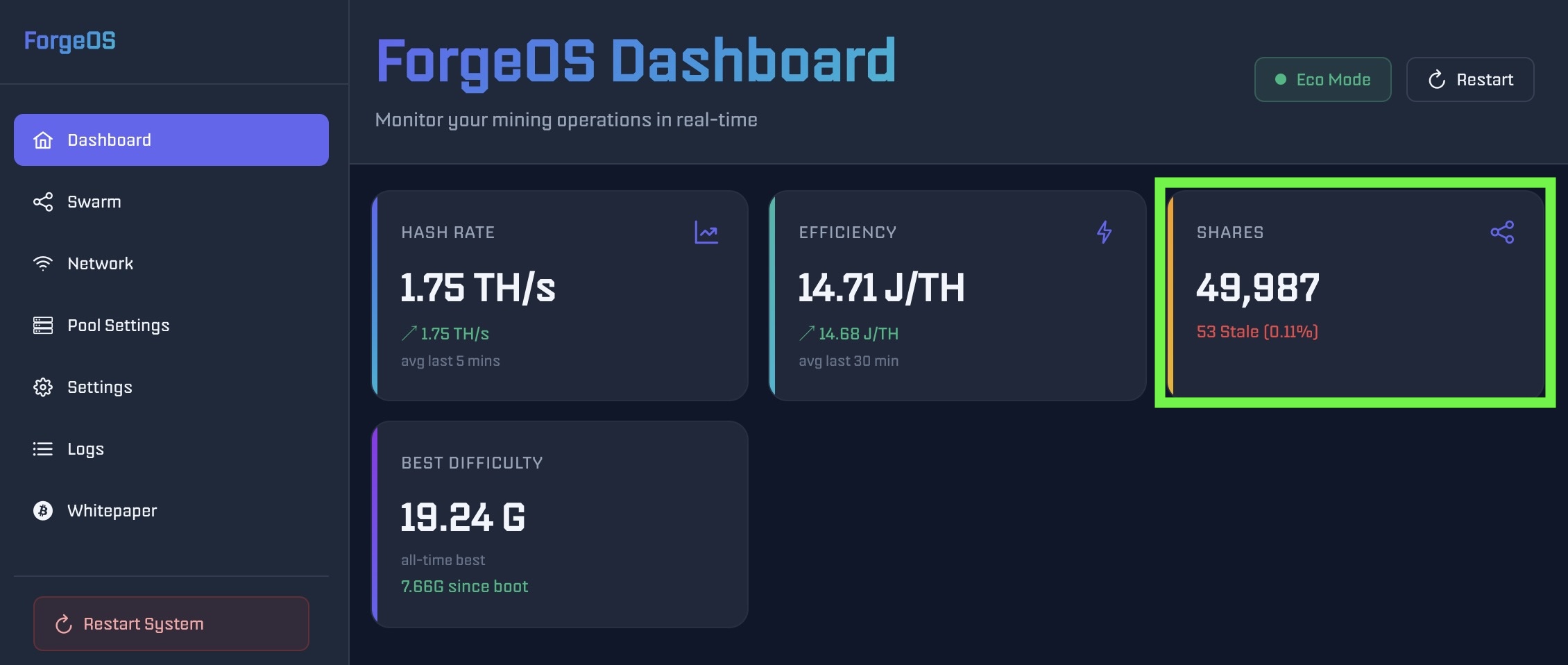
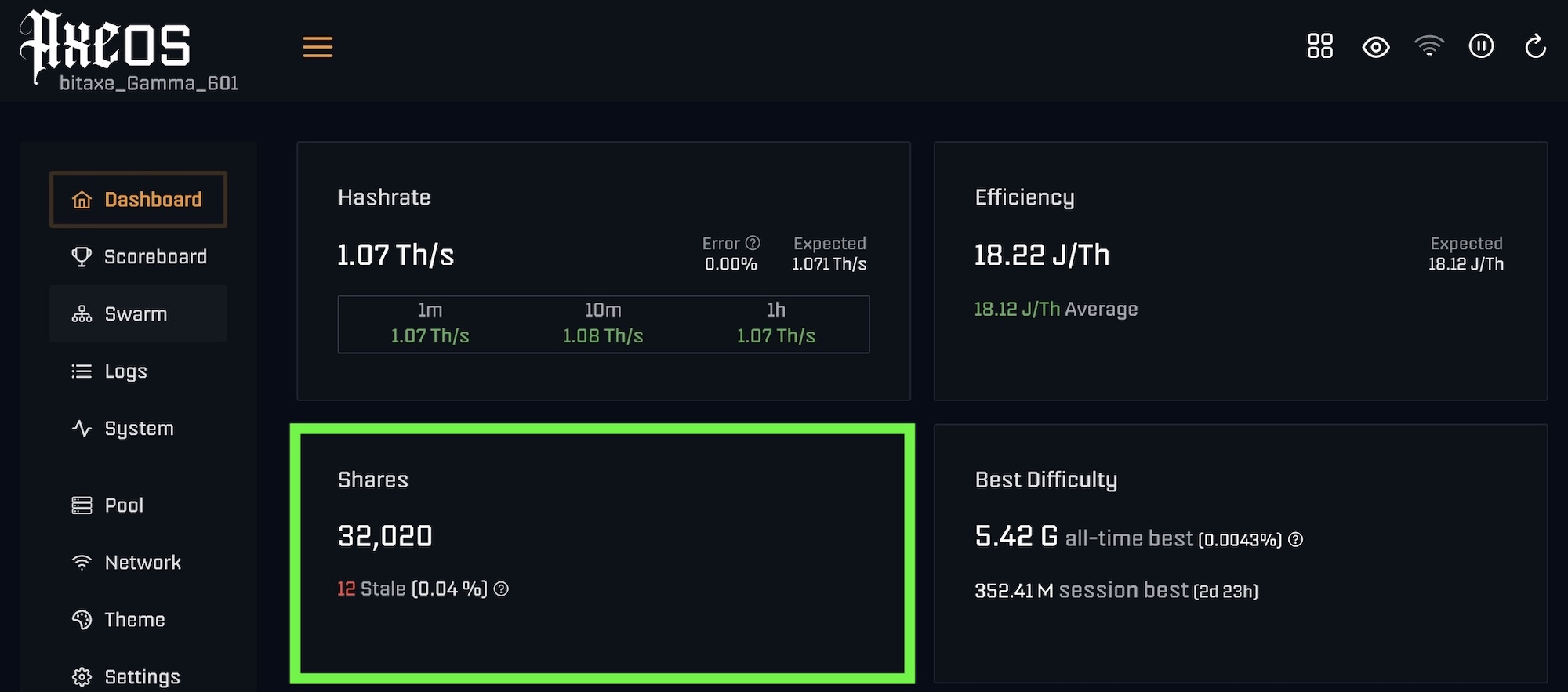
If you’ve ever plugged in a BitForge Nano or a Bitaxe Gamma and watched the dashboard tick over, you’ve seen the word “share” pop up again and again. It shows up in AxeOS, it shows up in ForgeOS, it shows up on your pool’s website. But what actually is it?
Short answer: a share is proof that your miner is working. It’s not Bitcoin. It’s not money. It’s a receipt.
Let’s break down why that receipt matters so much.
👉 Get the Bitforge Nano with BTC or Fiat on the DTV Electronics Store (Worldwide) 🌍
👉 Get the Bitforge Nano with Fiat on Amazon (Worldwide) 🌍
The Basic Idea
Every Bitcoin miner does one repetitive job. It takes the current block header, tacks on a random number called a nonce, and runs the whole thing through SHA-256. Out comes a 64-character string of letters and numbers. If that string is small enough, smaller than the target set by the network’s difficulty, you’ve just found a block. And a block is worth real money: 3.125 BTC right now, plus whatever fees are sitting in the transactions you bundled in.
Here’s the catch. Network difficulty in 2026 sits above 110 trillion. A single BitForge Nano or Bitaxe Gamma isn’t going to stumble into a valid block hash very often. It could take years, honestly. So how do you know your device is even doing anything in the meantime?
That’s where shares come in.
A share is a hash that clears a much lower bar than the full network target. Your pool sets this bar deliberately low so your miner can clear it often, sometimes multiple times a minute. Each time it happens, your device fires off that result as a share. The pool checks it, logs it, and moves on.
Think of it like target practice. Solving a block is hitting a bullseye from half a mile away. A share is proof you can hit the target at all, just from much closer range. It tells everyone your gun works and your aim isn’t garbage. It doesn’t win the match by itself.
Why Solo Miners Bother With Shares at All
Here’s a question people ask a lot. If you’re solo mining with a BitForge Nano, you’re not splitting rewards with anyone. So why submit shares?
Because solo miners still connect through a pool interface, usually Atlas Pool or a self-hosted Public Pool node, to handle the plumbing of building and broadcasting blocks. And that connection needs a way to verify you’re actually online and hashing.
Shares do three things for you as a solo miner:
They prove your hardware is alive. If your Bitaxe Gamma stops sending shares, something broke. Maybe the Wi-Fi dropped. Maybe the chip overheated and throttled itself into silence. Either way, you find out fast instead of discovering three days later that your miner has been sitting idle.
They estimate your hashrate. Pools can’t peek inside your ASIC and count hashes directly. Instead, they watch how often shares arrive and back-calculate your speed. Slower share rate, lower reported hashrate. It’s an educated guess, but a pretty accurate one over time.
They catch the winning hash. Every share has a tiny, tiny chance of also beating the full network difficulty. When that happens, the pool doesn’t sit on it. It broadcasts the block instantly and routes the reward straight to your wallet address. Without that submission pipeline in place, your device could theoretically find the golden hash and have nowhere to send it.
Accepted, Rejected, and Stale: Not All Shares Are Equal
Your dashboard is going to show you three flavors of shares, and it’s worth knowing what each one means.
Accepted shares are the good ones. They cleared the pool’s difficulty bar and arrived on time. A healthy setup should be accepting well over 99% of what it submits.
Rejected shares failed validation somewhere along the line. Usually this traces back to a bad Wi-Fi signal, a corrupted packet, or your device working off an outdated block template. If your rejection rate creeps above one or two percent, move your BitForge Nano closer to the router or hop it onto a quieter 2.4GHz channel.
Stale shares are a special case of rejected. The work itself was valid, but a new block got found somewhere else in the network before your share arrived. Since Bitcoin produces a new block roughly every ten minutes, this is bound to happen occasionally. It’s not really a hardware problem, more a timing quirk baked into how the network operates.
| Share Type | What Happened | Effect on You | Usual Cause |
|---|---|---|---|
| Accepted | Valid work, delivered on time | Counts toward hashrate, could solve a block | Normal operation |
| Rejected | Failed pool validation | Wasted work, no credit | Weak signal, bad data |
| Stale | Valid work, arrived too late | Wasted work, mostly unavoidable | New block found elsewhere |
Share Difficulty vs. Network Difficulty
These two numbers get confused a lot, so let’s separate them clearly.
Network difficulty is the real target. It’s what determines whether you’ve actually solved a block. It adjusts roughly every two weeks based on how much total hashrate is pointed at the Bitcoin network (difficulty adjustment).
Share difficulty is a local, much easier target your pool assigns just to you. It has nothing to do with solving blocks directly. It exists purely so your device can submit proof of work often enough to be tracked properly.
Every single hash your BitForge Nano or Bitaxe Gamma produces gets measured against both numbers at once. Almost all of them clear the share difficulty and fall nowhere near the network difficulty. Every once in a very long while, one clears both. That’s your block.
| Term | Set By | Purpose | Typical Value (early 2026) |
|---|---|---|---|
| Share difficulty | Your pool | Track uptime and estimate hashrate | Low, adjusted to your device |
| Network difficulty | The Bitcoin network | Decide if a block is actually solved | 110+ trillion |
Best Difficulty: Your Closest Near-Miss
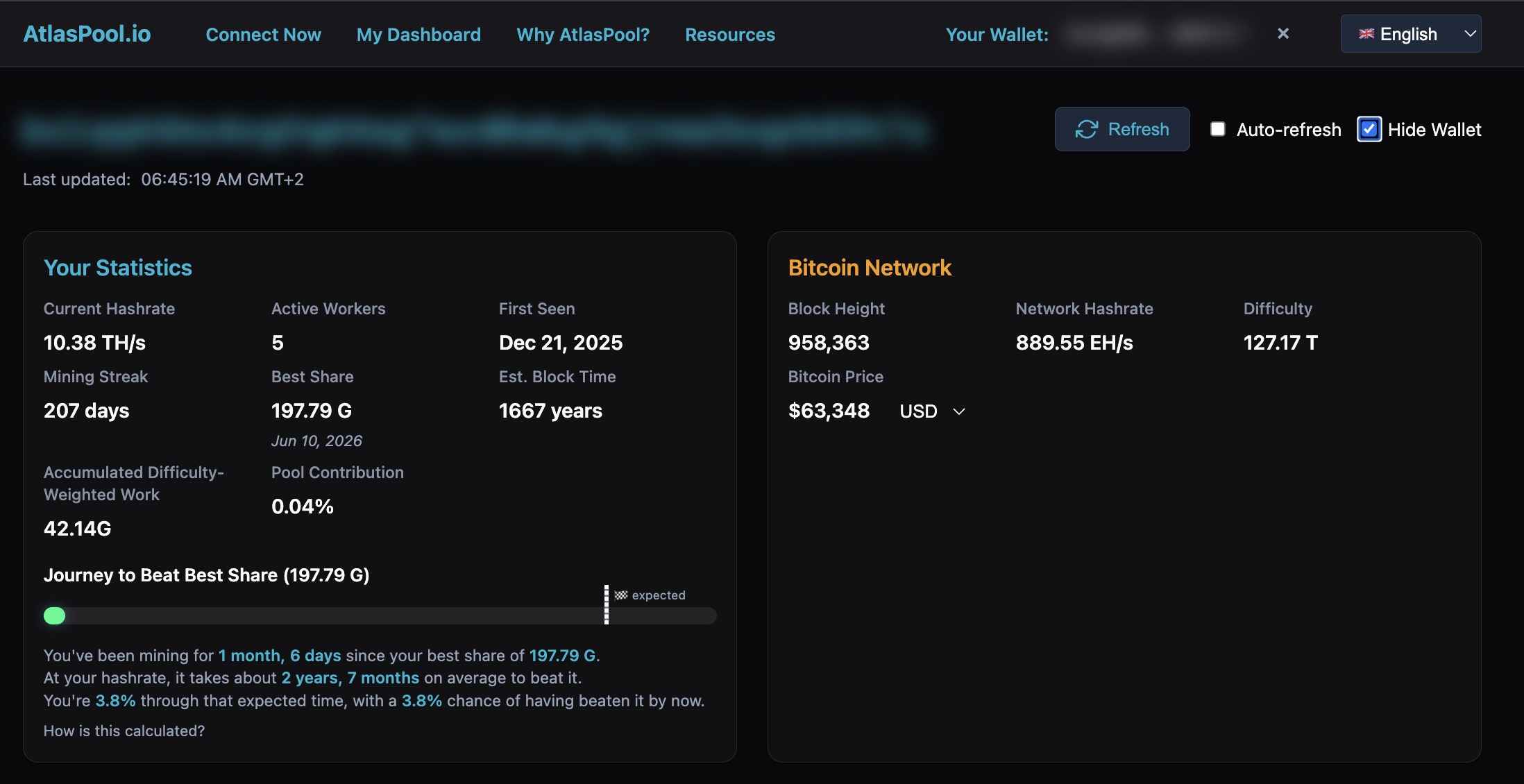
Somewhere on your AxeOS or ForgeOS dashboard, there’s a stat called “best difficulty.” It’s the single highest difficulty share your device has ever produced. Basically, it’s the closest your BitForge Nano or Bitaxe Gamma has ever come to solving a block.
It’s a fun number to watch. It’s also a bit misleading if you read too much into it. Each hash attempt stands completely on its own. A high best difficulty doesn’t mean you’re “due” for a block any more than flipping heads five times in a row makes tails more likely on the sixth flip.
Real Blocks That Started as Ordinary Shares
This isn’t just theory. DTV Electronics devices might have actually done this.
On November 21, 2025, a cluster of six Bitaxe Gamma units running on Solo CKPool submitted a share with a difficulty of 221.39 T, high enough to clear the network target at block height #924,569. That single share turned into 3.08 BTC, worth roughly $266,000 at the time, paid straight to the miner’s wallet.
More recently, on July 10, 2026, a Bitaxe Gamma likely found block #957,382 solo. Same story, different day: millions of ordinary shares submitted with nothing to show for it, until one of them cleared the full network difficulty and turned into a real payout.
| Block Height | Date | Device | Approx. Combined Hashrate | Pool |
|---|---|---|---|---|
| #924,569 | November 21, 2025 | Bitaxe Gamma (6-unit cluster) | ~5.4 TH/s | Solo CKPool |
| #957,382 | July 10, 2026 | Bitaxe Gamma | Single unit | Hosted Public Pool |
Every one of those blocks began life as a boring, routine share. Nobody’s device “knew” it was about to strike gold. It just kept hashing, kept submitting shares, and eventually one of them was the right one.
Pool Mining vs. Solo Mining: Shares Work Differently
If you’ve mined on a traditional pool before, the share concept is going to feel a little different in solo mode.
In pool mining, every accepted share earns you a small slice of the next reward, based on how much of the pool’s total work you contributed. Systems like PPLNS, TIDES or PPS use your share count as the accounting method for splitting payouts. More shares, steadier income, smaller checks.
In solo mining through Public Pool or Atlas Pool, shares don’t pay you anything on their own. They’re purely for monitoring and for catching that one lucky hash. You get nothing until a share clears the full network difficulty, and then you keep the entire block reward yourself. People sometimes call this lottery mining, and honestly, that’s a fair description. Each share is a ticket. The jackpot is the whole 3.125 BTC.
Getting More Shares Out of Your Device
More shares generally means more actual hashing happening, which means better odds over the long run. A few practical steps that actually move the needle:
Tune your clock speeds. Both the BitForge Nano and Bitaxe Gamma allow frequency and voltage adjustments right in their firmware. Small, careful bumps can squeeze out meaningfully higher hashrate without pushing the chip into instability.
Fix your cooling. More hashrate means more heat. Fresh thermal paste, a better heatsink or an extra fan keeps your ASIC running at full speed instead of throttling itself down when temperatures climb.
Add more units. Hashrate stacks. Running several BitForge Nano or Bitaxe Gamma devices side by side multiplies your total share output, and every block ever solved by open-source home hardware has come from someone running more than a single unit.
Nail down your Wi-Fi. DTV Electronics devices connect over 2.4GHz only. A shaky connection is the single most common cause of rejected and stale shares. Keep your device within clear range of the router, or set up a dedicated access point just for your mining rack.
The Bottom Line
A share has no value to the Bitcoin network. It won’t buy you coffee, and nobody will accept it as payment. But it’s the mechanism that makes home mining possible at all. It proves your BitForge Nano or Bitaxe Gamma is actually working, it lets your pool estimate your real hashrate, and it’s the tripwire that catches the one hash out of trillions that actually solves a block.
Every accepted share is a small, quiet step toward that outcome. Most of the time, nothing comes of it. And then, every so often, block #924,569 or #957,382 happens, and a routine share turns into a life-changing payday.
👉 Get the Bitforge Nano with BTC or Fiat on the DTV Electronics Store (Worldwide) 🌍
